Showing posts with label Russian Campaign of 1812. Show all posts

Friday, April 29, 2016

New Figures and Some Updates

Hello everyone!

It's been a long while since my last post, and even longer since my last proper wargaming post. Shame on me! In my defense, I've been rather busy at work lately, and since I still haven't been able to move off the ship (hopefully this will be accomplished before summer's end) there hasn't been much for me to post about.

I did end up purchasing every book in the Hornblower saga, as well as another Jack Aubrey/Stephen Maturin book and "The Letters of Captain Coignet," a first-person account of the Napoleonic Wars from the perspective of a solider in Napoleon's Old Guard. There might be a few other books I've bought too, but I can't remember right now.

Also, the article on the Ancient Irish Regiment of Fencible Infantry that I mentioned I was working on in my last post has ballooned considerably, and is now entitled "The History, Organization, Uniforms, Colours and Awards of the Irish Fencible Regiments, 1794-1802" and is currently over 50 pages in length. It's quite close to being done, and I'll post a link to it in a new tab at the top of the page when it's complete.

Enough dithering, and on to the minis!

I picked up a mixed lot of 15mm figures off of eBay the other day for relatively cheap. They were marked as being Russians, though when I received my parcel I found that it wasn't just Russians, but quite literally a mixed bag of troops. To be fair, though, they're mainly Russians.

(Remember to click on the pictures for bigger versions.)

The Russians

The majority of the lot consisted of these chaps, 26 Russian infantry in soft caps. As you can see, the vast majority of these have already been primed by their previous owner. The 24 lads at the bottom of the photo are musketeers, while at top are a standard bearer and a drummer.

The lot also contained 8 Russian infantry in kiwer, 4 of them already painted! The other 4 consist of a pair of officers and a pair of standard bearers.

Finally, we have 14 mounted and dismounted Russian officers. The 5 at top left have had their coat and hat colors blocked in; 2 wear kiwers, the rest wear bicornes, and there was only one horse for them. At top right are three Russian mounted officers with their mounts, two wearing bicornes, the third wearing a soft cap. I'm fairly certain these are old Minifigs. Finally at the bottom are two sprues of three Russian dismounted officers, all wearing bicornes. I believe these are old Minifigs as well.
The French

Also included was 11 Frenchmen. At top left we have three French officers, possibly generals or Marshals. At top right we have Napoleon himself, along with Roustan and a dismounted Chasseur a Cheval. In the middle of the picture are four dismounted French infantry officers, as well as a Frenchman in a bearskin, making him either an Old guard officer or a member of the Grenadiers a Cheval.
The Hussars
Four Hussars were in the bag. Due to the Hussar uniform being nearly identical in every warring nation (at least in 15mm, that is), these guys could work for any nation. At left is a Heritage figure, with the two at the right (with separate horses) I'm pretty sure are from Essex. The little one in the center I have no clue as to the origins.

The Prussians?

I'm pretty sure the dude at the far left is a Prussian artilleryman, but he'll probably be pressed into service in another army, along with the heavy cavalryman and the lancer in the center. The lancer at the far right might be a Prussian, but then again he could be a Cossack. I'm not sure.
The Broken/Not-In-My-Wheelhouse Figures

Up top is a self-propelled artillery piece: maybe 6mm? Something small, anyway. At top right is a 28mm radio set sitting on a stump, while along th bottom are 4 invalids: Two Russian standard-bearers with their flagpoles clipped off, a Russian mounted officer without a right hand, and a French infantryman without any feet.
All told I ended up with 71 figures, not including the stump radio and the self propelled gun. I paid less than $25 for the lot, so it wasn't a bad deal at all.

Coming soon: a new "Articles" tab at the top of the page with my completed article, and hopefully soon I'll be able to sit down and get some painting done; I still have my Nassauers to work on...

Questions, comments and suggestions are always welcomed and appreciated. Thanks for looking!

-Chuck

Thursday, September 17, 2015

More 28mm Sash & Saber ACW Figures Converted to Napoleonic Casualties

Hello everyone!

Another quick post tonight. Based on the success of the last casualty figure I did based on a Sash & Saber ACW figure I had lying around, I took another look at the other minis I had. While I only have a small number of ACW casualty figs (which I will probably never use), most of them have very distinctively late 19th Century uniforms and equipment, that would not be conducive to conversion. I did, however, find two that, with a little carving, sculpting, creative painting, and a fair amount of research for one fellow in particular, would work, and I present them here now. (Remember to click on the pictures for bigger versions.)


The lad in green is meant to depict a dead Russian. The original ACW figure already had a blanket roll, so I decided to use him basically "as-is"--really the only conversion I had to do was some trimming and greenstuffing to turn his anachronistic kepi into a flat forage cap. The forage cap allows this guy to be used with any of my Russian units, to include my Pavlovs. I think it worked out rather well. The original Sash & Saber fig was wearing an open shell jacket, so I painted this as a coatee that had been opened by the victim to get at his wound: a nasty (an fatal) gutshot.

The gentleman in red is another dead Briton, this time in the dark green facings of the 51st (2nd Yorkshire West Riding) Regiment of Foot, a regiment of light infantry, though he will represent any British unit that is in need of casualty markers. Why light infantry? Because of his curious choice of kit, namely his blanket/greatcoat blanket sling. When I first looked at this ACW figure, I wondered if I could use him as a Napoleonic casualty because of the figure's rolled blanket strapped across his back. Now I had never heard of such a practice being used in any of the armies I collect, nor had I read of this used in the Napoleonic Wars at all. So I fired up Google and went to work, and what I found surprised me. I actually found a blog post about a group of AWI reenactors who discussed blanket slings, and in fact had a number of pictures contemporary to the Napoleonic Wars of British soldiers using them both in 1800 and in 1808 at Corunna, as well as a picture of an extant British blanket sling dated 1804 (the blog post can be found here):

In use in 1800
 
At Corunna in 1808

An actual surviving blanket sling, dated 1804
During summer campaigning troops would often leave their knapsacks with the baggage to have less of a load to bear, and I would imagine that lightly equipped, fast moving and overall sneaky formations such as light infantry regiments (like the 51st) would have taken to such devices readily. I had never heard of blanket/greatcoat slings until I read about this, and I was pleased to have learned something new. When it boils down to it, isn't that why any of us really games, to learn new things about our favorite eras of history? Situations like this are the reason why I've stuck to this hobby over the years while others have fallen to the wayside.

Other than the research to justify my figure choice, really the only converting I had to do was to use greenstuff to make a shoulder strap for his cartridge box. Evertything else is just clever painting to bring this ACW fig back to the Napoleonic Wars.

Coming soon: probably some Brits, either West Indies Regiment or the King's Own, though I feel that my French could use some loving... Then again, getting the green out for my Russian casualty was satisfying too... we'll see.

Questions, comments and suggestions are always welcomed and appreciated. Thanks for looking!

-Chuck

Sunday, August 16, 2015

French Old Guard Chassuers a Pied 15mm Figure Review

Hello everyone!

A promised, here's the review of the latest miniatures that I received, some 15/18mm French Old Guard Chasseurs a Pied figures from Napoleon at War and Essex.
 
Napoleon at War French Old Guard Chasseur a Pied Battalion
&
Essex French Old Guard Chasseur in Greatcoat and Bonnet de Police Review

The blisters as they arrived in the mail.

Initial Impressions

As has been the case recently, I purchased these figures when I found them on sale at very good prices in the bargain section of one of my favorite online retailers. While I've bought Essex figures in the past and knew about what to expect from them, I was curious about the Napoleon at War figures, which are produced by a Spanish company called Man at War Miniature Games. These figures are bulk packed with included bases, I'm assuming to be used with Man at War's own proprietary ruleset, but the large number of figures per pack piqued my interest: it was nearly enough for one of my 36 man battalions. The pack was advertised as containing 32 figures, but when I broke it open and started counting, it turned out to contain 33! Bonus! At the price they were on sale for, I couldn't resist the deal. Unfortunately, in my opinion, these are the few positive points I've found regarding these figs.

The contents of the Napoleon at War battalion pack: A selection of bases for Men at War's proprietary rules, 20 marching figures, 8 skirmishing figures in four different poses, and 5 command figures, including an Eagle bearer, an Officer, two sergeants (one with a porte fanion), and a drummer. So 33 figures in all, of an advertised 32. Bonus!

Scaleability

The Napoleon at War figures are approximately 18mm or largish 15mm; it's hard to say for sure, as the minis are sporting the rather large bearskins worn by the Old Guard. I believe that these figures would fit in height wise with AB and Fantassin figures, but never stylistically; these figures are definitely from the "rough and ready" school of sculpting. The Essex figures are the same old same old. They may be Napoleonic dwarf lords, but at least they are consistent.

The more mundane contents of the Essex pack: 8 standing or marching French Chasseurs a Pied in greatcoats and bonnet de police.

Quality

As I mentioned, the Napoleon at War minis are very rough and ready. The sculpting on these guys makes the Essex figures look like masterpieces; overall, they are kind of lumpy, with mushy details. The metal is also really, really soft; I could see the rifles and bayonets on these lads bend and break quite easily if they were mishandled or dropped. In my humble opinion the quality on these guys is severely lacking and probably one of the worst things about these figs.

Other than production values, the figures are wearing the appropriate equipment and uniforms to represent the Old Guard Chasseurs a Pied. It's also neat that the Essex figures are wearing the bonnet de police fatigue cap, which from what I've read was quite popular amongst French troops of the era.

Size comparison between the two manufacturers. The larger overall size of the Napoleon at War figures (18mm vs. 15mm for the Essex figs) plus the tall bearskins make them tower over Essex's Napoleonic gnomes.

Price

The good price I got on both of these packs of figures is why I bought them in the first place. Frankly, if I hadn't have gotten the Napoleon at War figures at a deep discount (I paid $7.19 for them--$0.21 per figure--when they normally run $25.88), I would have felt sick paying $0.78 per figure for them: that's higher than AB figures, and with much lower quality! The Essex figures were also slightly discounted as well, but their prices have always been consistent for what you get from them.

All in all I'm a bit disappointed in the quality of the Napoleon at War figures for what they charge for them. They do come in large packs which is nice for guys like me who have large numbers of figs per unit, but the high prices for low quality is not good. However, I got mine cheap, and if you can too, then you'll have some decent figures to flesh out your armies. I'm looking forward to having some Old Guard to protect the Emperor from the damn Ruskies!

-----

Coming soon: I should be getting my 12 pounder for my American artillery from Brigade Games sometime this week, and I'll post some pics when it arrives. I'll also be on the lookout for my Knuckleduster figs as well.

Questions, comments and criticism are always welcomed and appreciated. Thanks for looking!

-Chuck

Wednesday, July 22, 2015

Great Deal on a New Rulebook Expansion (For Me)

Hello everyone!

It seems like all I do is post more books to this blog nowadays instead of minis... oh well. Another book came in the mail for me... yesterday? I'm pretty sure it was yesterday. Here's Triumph of Nations, the 1809-1815 expansion for Field of Glory: Napoleonic, written by Terry Shaw and Mike Horah.

Triumph of Nations, written by Terry Shaw and Mike Horah
As readers of this blog may or may not know, I picked up the core set of rules, Field of Glory: Napoleonic, back in January for use as a "big battles" ruleset. Triumph of Nations is a supplement to the core rules, establishing army lists for number of different campaigns in from late 1809 through the 100 Days and the final defeats of Napoleon in 1815. Useful to me in particular are the lists for the French invasion of Russia in 1812, which includes both Russian and French/Allied army lists. This is but one of many campaigns covered, however, with lists for the 1809 Austrian Campaign, the British Walcheren Expedition, the Russo-Turkish Wars, the 1813 Campaign, the 1814 Invasion of France, and the 1815/100 Days Campaigns. While I normally game the Peninsula, the 1812 Invasion of Russia and the American War of 1812, a lot of these other army lists make my mouth water a little bit... must resist!

Really the only reason I picked this book up was because I found it cheap. Whilst browsing through the discount section of one of my favorite online wargaming stores, I saw that this one had been added. While normally selling for $34.95 (or so the back cover tells me), I paid a mere $8.74! I couldn't pass up that kind of deal, even if it isn't 100% tailored to what I normally game.

Scattered throughout the book are snippets of information about the campaigns covered, which his handy for any scholar of the period. The quality of the book is excellent; well laid out, nice printing, and nice solid hardback cover. All in all I'm quite pleased with this purchase.

Coming soon: maybe some more French that I started back in May and never finished. I did put the flock on those older bases from when I didn't have Elmer's glue, so I'll post some follow up pictures of those as well.

Questions, comments and criticisms are always welcomed and appreciated. Thanks for looking!

-Chuck

Friday, January 30, 2015

The 1st Battalion, Pavlovsk Grenadier Regiment: Complete!

Hello everyone!

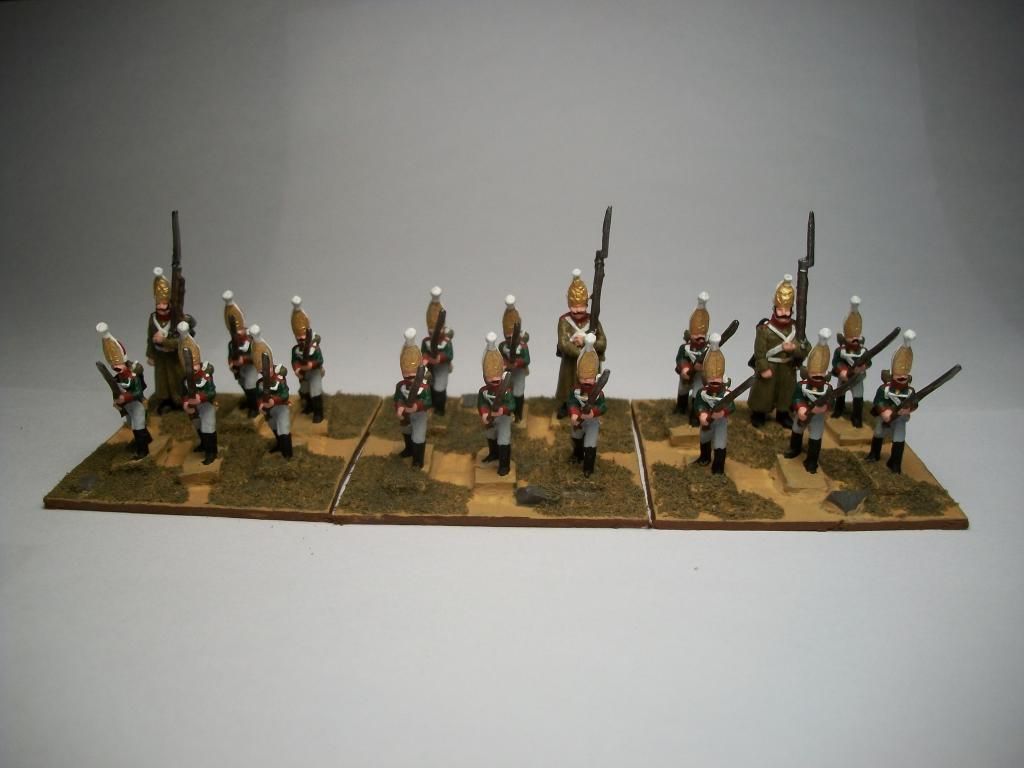
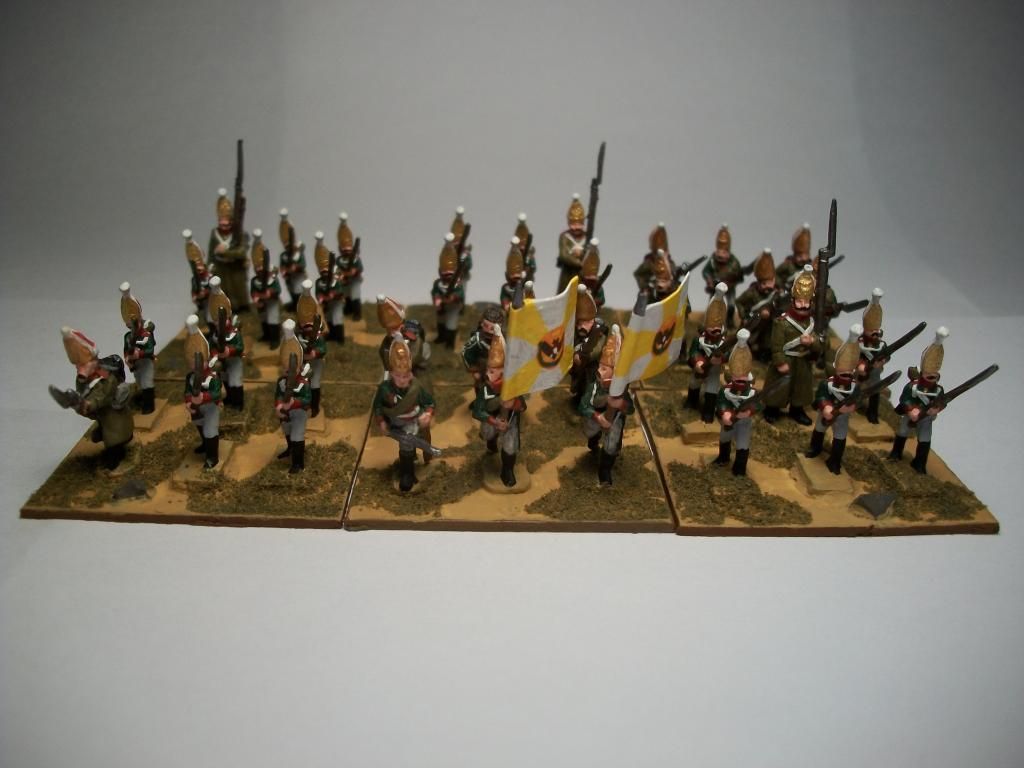
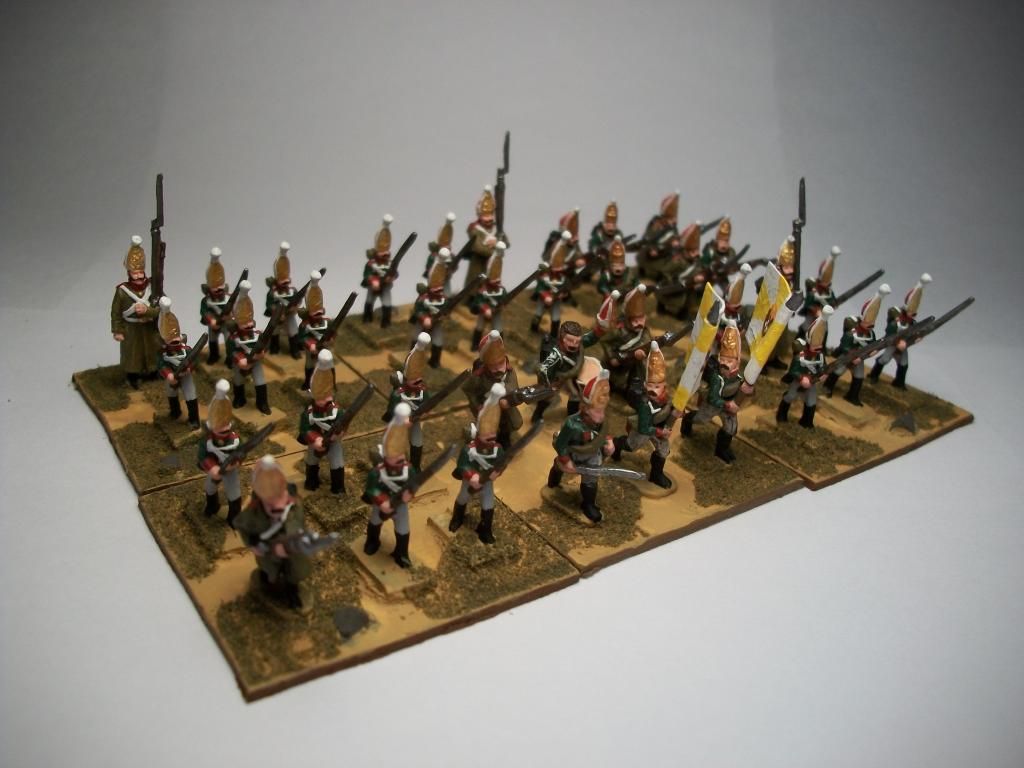
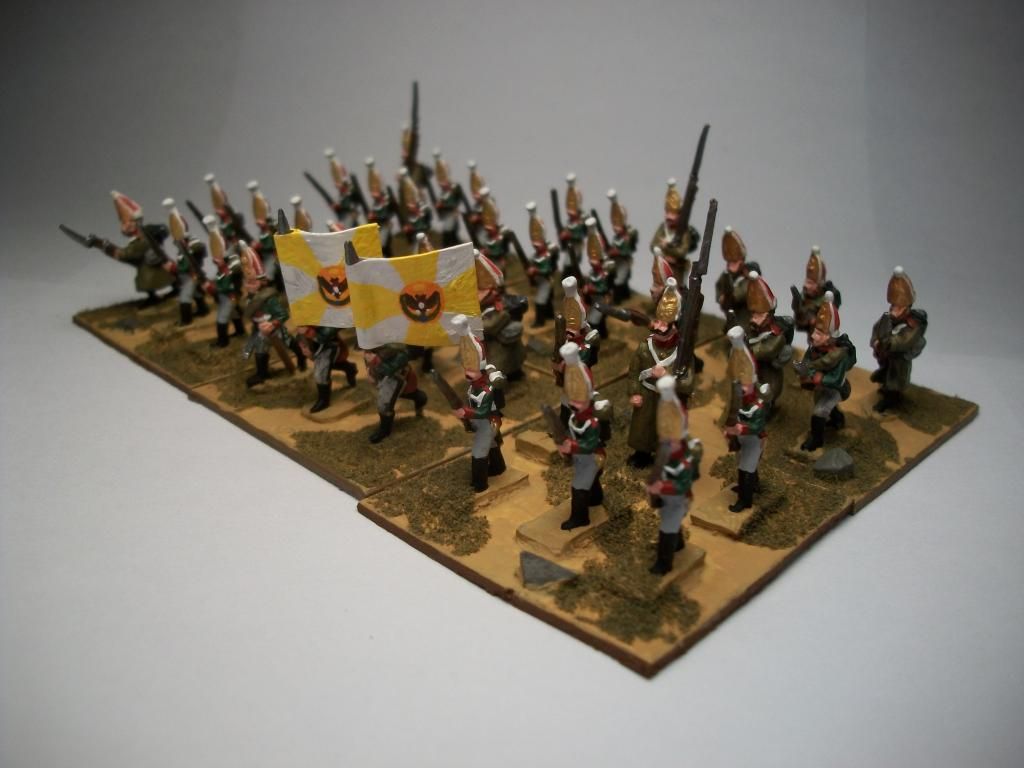
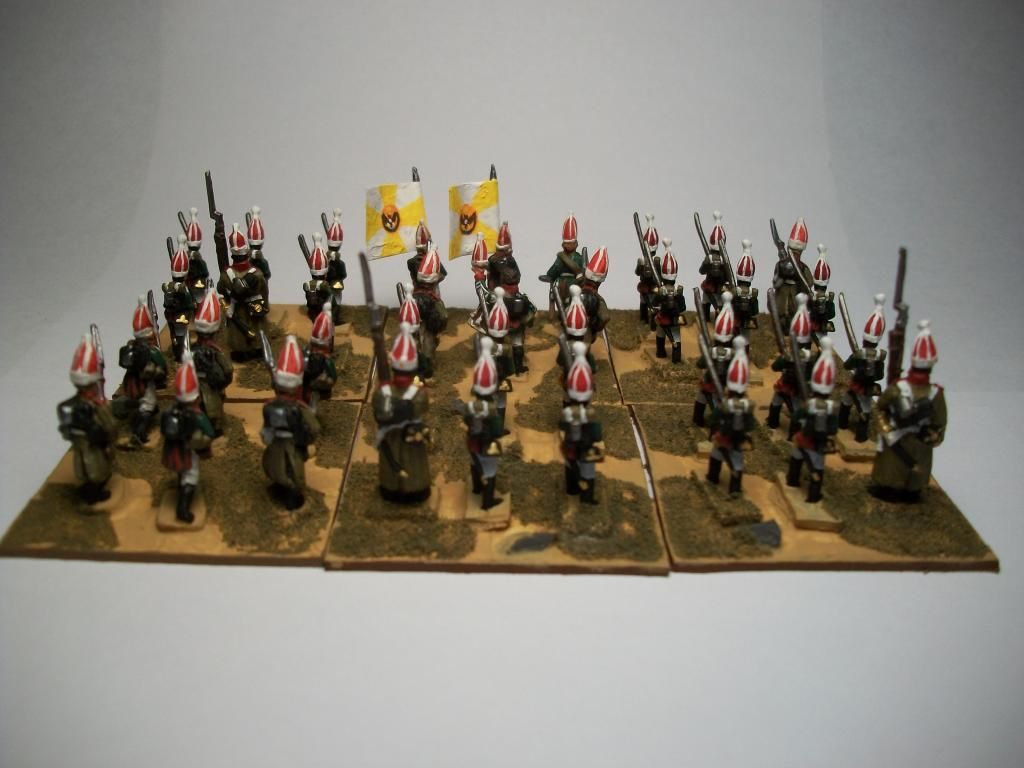
In a two-day whirlwind of painting I managed to finish up the other three stands of figures and now the 1st Battalion of the Pavlovsk Grenadier Regiment is complete!

(Remember to click on the pictures for bigger versions.)

The eighteen Pavlovs I completed most recently; note the height difference between the Minifigs and AB grenadiers.


A view of the Pavlovs that few Frenchmen will ever see; unless the Cossacks have broken into the Regiment's vodka.
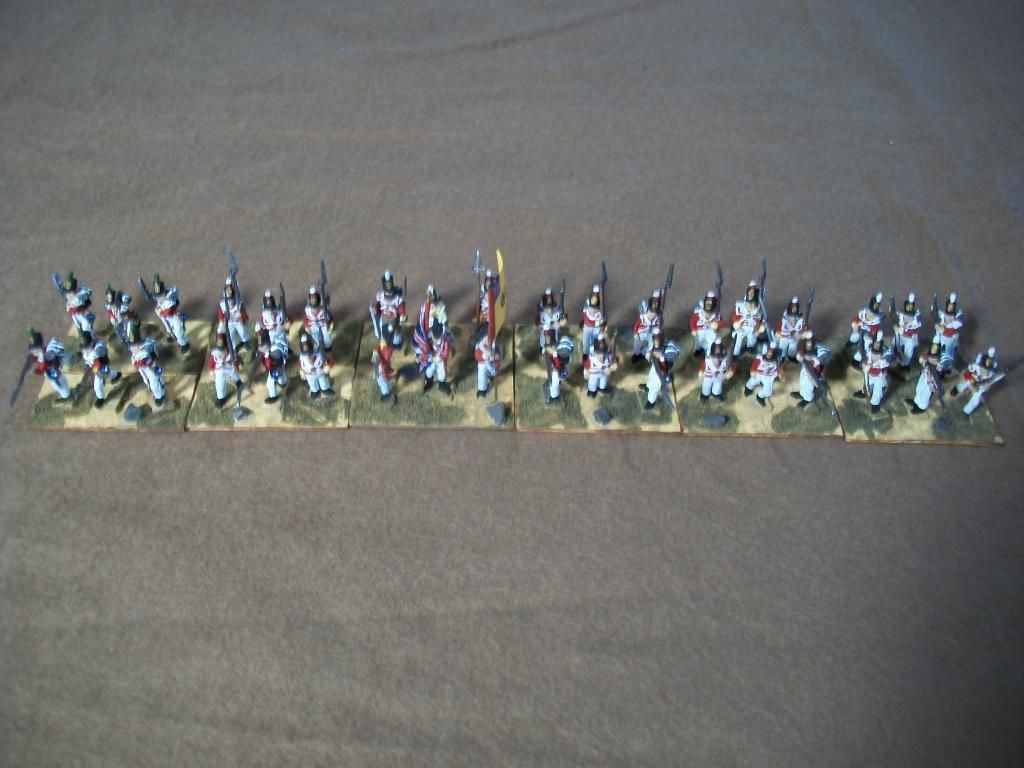
The final three stands are mostly old Minifigs, with three AB Pavlovs in greatcoat added to make up the numbers. The AB figures tower over all of the Minifigs, but AB is one of the few companies out there that sell their figures individually, and I only need three to flesh out the regiment. Also, them being in greatcoat ties my painted stands in with the figures that came already painted that makes up one third of my Pavlovs.

As I've done a bit more research into the TO&E of the Russian Army prior to 1812, I've learned that most Russian regiments fielded two battalions, the Pavlovs included. So in the future I will have to paint up a second battalion to complete the Pavlovsk Grenadier Regiment according to the Borodino OOB, which is fine by me since the Pavlovs have such fetching mitres.

Purchased Figures

Well, I had told myself that I wasn't going to be buying any more figures before I left for boot camp, mainly because I wouldn't be able to see them until well into the summer. This resolution has gone by the board, and there are now over 100(!) 1/72 scale figures on their way. But hear me out: I just couldn't pass up the deal I found on eBay.

The lot I found was unmarked as to what was in it (the descriptions only saying "American Revolution/Napoleonic?"), but thanks to Plastic Soldier Review I was able to determine that the lot consisted basically of the contents of Italeri #6066 French Infantry, Strelets #018 Russian Mounted Jagers, and Italeri #6060 American Infantry (from the American War of Independence), plus a mystery plastic mounted figure that I'll have to scrutinize once I see it. All in all it should amount to 109 figures, all at the price of $5.50 shipped! That's five cents a figure! As I said, it was a deal I couldn't possibly pass up.

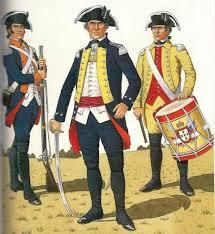
I'll use the French Infantry for their intended purpose, use the Russian Mounted Jagers as Russian Dragoons (they wore practically the same uniforms, as the mounted jagers were converted from dragoon regiments late in 1812) as the jagers were formed too late for Borodino, and the AWI American Infantry as pre-1806 Portuguese infantry, which wore distinctively old-fashioned uniforms before the Barretina shako was introduced.

Portuguese Infantry, 1790s-1806, wearing handsomely old-fashioned uniforms that are strikingly similar to AWI uniforms.
Will I have any use for a unit of Portuguese in these old uniforms? Probably not, but they'll look classy anyways. But, like I said, I won't get to see them until late this summer, so I'll have something to look forward to and something to post about later.

Coming soon: This is probably the last painting I'll get done before I leave for boot camp Monday morning, unless by some miracle my French Foot Dragoons arrive tomorrow so I can put up a review and knock out a stand. I don't want to get started on something and then have to leave it half finished for five or six months. We'll just ahve to see what Mr. Postman brings.

Questions, comments and suggestions are always welcomed and appreciated. Thanks for looking!

-Chuck

Wednesday, January 28, 2015

More Pavolvsk Grenadiers

Hello everyone!

I was able to quickly paint up another stand of Russian Pavlovsk Grenadiers, bringing the regiment up to half strength (remember to click on the pictures for bigger versions).


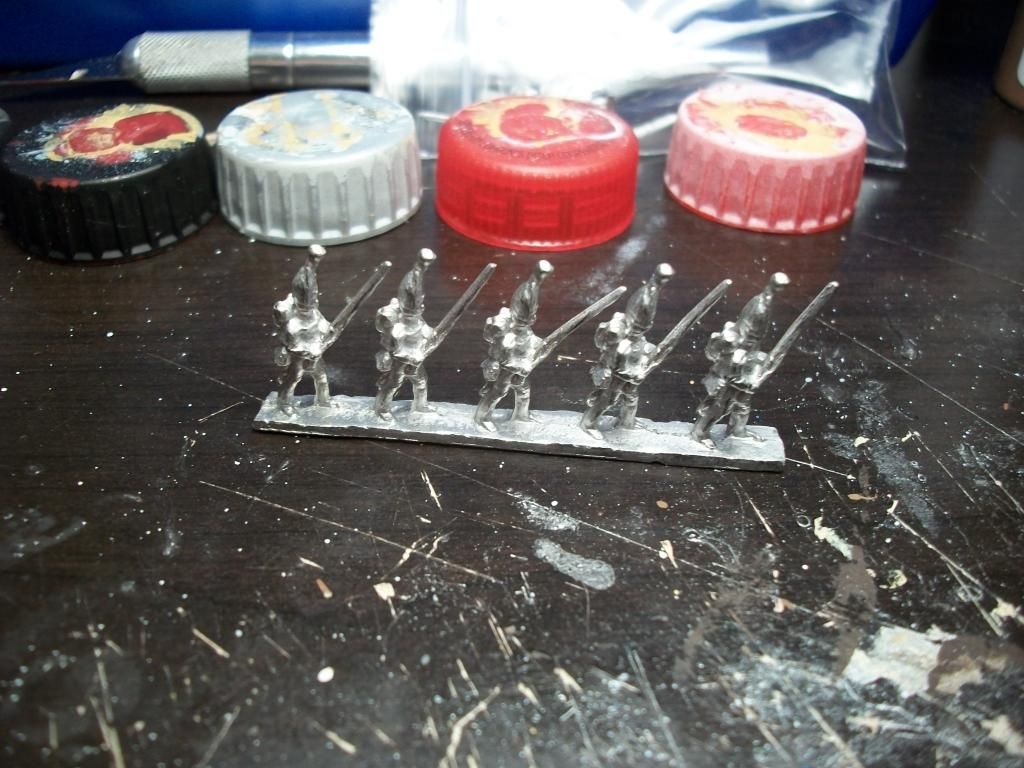
The chap in the greatcoat came already painted in an eBay lot that I won last month, and only needed a few touch-ups and a new skin tone to complete (still counts as a painted fig in my totals though!). The other five are all old Minifigs that I also won on eBay; these were in a strip of five figures that I had to clip apart.

The old Minifigs, five to a strip.
These guys are so easy and quick to paint that I got them done in no time.

Coming soon: As quick as these Grenadiers were to paint, I may try to get the whole regiment done before I leave for boot camp. Also, if my French Foot Dragoons arrive before I leave I'll try to put a review up, and maybe paint a stand's worth as well. We'll see.

Questions, comments and suggestions are always welcomed and appreciated. Thanks for looking!

-Chuck

Tuesday, January 27, 2015

The Bravest of the Brave

Hello everyone!

A quick post today. My painting mojo was strong last night and this morning and I was able to quickly finish up another French Marshal: Michel Ney, Duc d'Elchingen!

(Remember to click on the pictures for bigger versions.)


These are all lovely AB figures, and painted up very quickly. In order to fill up part of the large base I tried my hand at creating a dead and fallen tree, which is just a painted twig; I thought it turned out rather well. The base is the same size base that I placed Marshal Murat on, which gives you a pretty good indication of the differences scale-wise between 18mm figures and 1/72 figures. Ney (in the center) his joined by a mounted infantry colonel to his left and an officer of the 13th Dragoons on his right.

Ney is my favorite Frenchman of the Napoleonic Wars. I'm not sure why, but I've always been taken with his agressive leadership style, as well as the fact that, due to both his temper and red hair, he was known as the "Firey Gascon." He was also called "Le Rougeaud" (which means "The Ruddy-Faced").

Ney was born to common parents in the Lorraine region of France, where he learned to speak both French and German. Thanks to the French Revolutionary Wars, Ney was able to rise from the enlisted ranks of the 4th Hussars to a commission in October of 1792. By August 1796 Ney was a general de brigade, and he continued to rise.

Ney became a Marshal on 19 May 1804, and served all over Europe in most of France's major campaigns, including the Battles of Elchingen (for his actions there he was awarded his dukedom), Jena, Magdeburg, Eylau, Guttstadt-Deppen, Friedland, Ciudad Rodrigo, Almeida, the Coa, Bussaco, Pombal, Redinha, Casal Novo, Smolensk, Borodino, Krasnoi, Berezina, Lutzen, Bautzen, Dennewitz, and Leipzig. He was supposedly the last Frenchman to leave Russia after the disasterous Russian Campaign, and was called "the bravest of the brave" by Napoleon for his fearless leadership. After briefly joining the Royalist Army after Napoleon's exile to Elba, he rejoined Napoleon in the Hundred Days and fought at Quatre Bras and Waterloo, where he is famously remembered for leading the massive French cavalry attack against Wellington's infantry squares.

After Waterloo, Ney was imprisioned and sentenced to be executed for treason; he requested and was given permission to give his firing squad the order to fire. Officially Ney was executed on 7 December 1815; unofficially there have been claims that Ney's death was faked (supposedly with the help of high-ranking Allied officers, including the Duke of Wellington) and the red-headed Frenchman was allowed to quietly emmigrate to the southern United States, where he lived into old age. I personally choose to believe that he faked his execution and escaped, not only because there is compelling evidence that this might have actually been the case, but also because it makes for a better story for a pretty cool guy.

Coming soon: I'm not sure. It needs to be something I can complete quickly... maybe some casualty markers?

Questions, comments and suggestions are always welcomed and appreciated. Thanks for looking!

-Chuck

Monday, January 26, 2015

1st Battalion, 88th Regiment of Foot, and More!

Hello everyone!

It's been a little while since I've been able to get anything posted up the the blog, and my only excuses are that I haven't had the time and I've been under the weather. But, this means that now that I have the time, I've come with a vengence! Today I've completed the 1/88th Regiment of Foot (the Connaught Rangers) for the Peninsula, as well as a stand of the 5th West India Regiment for New Orleans. I've also bought a few more figures since my last post, as well as a few books that might be of interest. So without further ado, here we go!

(Remember to click on the pictures for bigger versions.)

Painted Figures

I painted up the remaining thirty figures that I needed to complete the Connaught Rangers, which I started way over a year ago (you can see the command stand in detail here). Unlike the command, which were all AB figures, the rank and file are a mix of Fantassin 18mm and Essex 15mm. The Fantassin figures are on par size and proportion wise with the AB figures, but they are cruder in their sculpting style. The Essex figures are nice and clean, but look a little dwarfish. Anyway, here are the figures that I finished up:

The Irishmen of the 1/88th that I completed most recently...

...and the entire Battalion drawn up into line. General Picton (who commanded the 3rd Division) apparently had a love-hate relationship with these Irish soldiers, probably because, in Oman's words, the 88th was "the most Irish of all Irish regiments." However, it is apparent that he came to admire their tenacity in a fight. Check out this link for a nice concise history of the Connaught Rangers during the Peninsular War.

With the 1/88th finished, this completes the British 3rd Division's 1st Brigade, commanded by Henry Mackinnon at Fuentes de Onoro. Here's the entire brigade together:

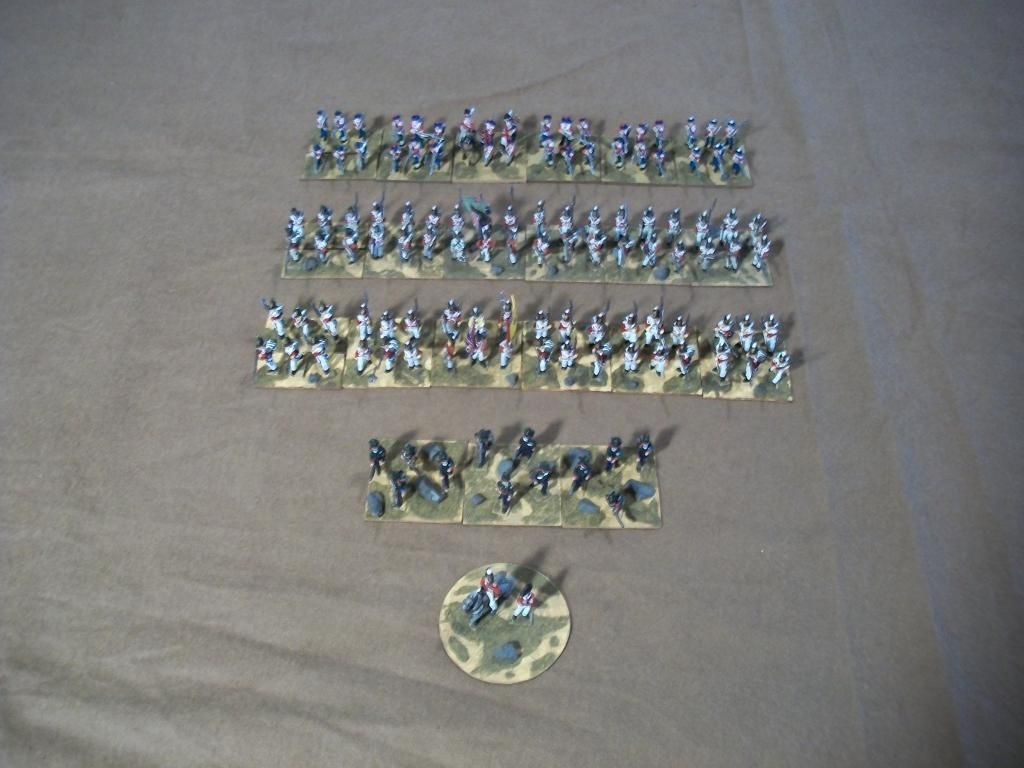
1st Brigade, Picton's 3rd Division. From front to rear: Henry Mackinnon, Brigade commander; 3 companies, 5/60th Regiment (Royal Americans)  1/88th Regiment (Connaught Rangers); 1/45th Regiment (Nottinghamshire); 1/74th Regiment (Highland).
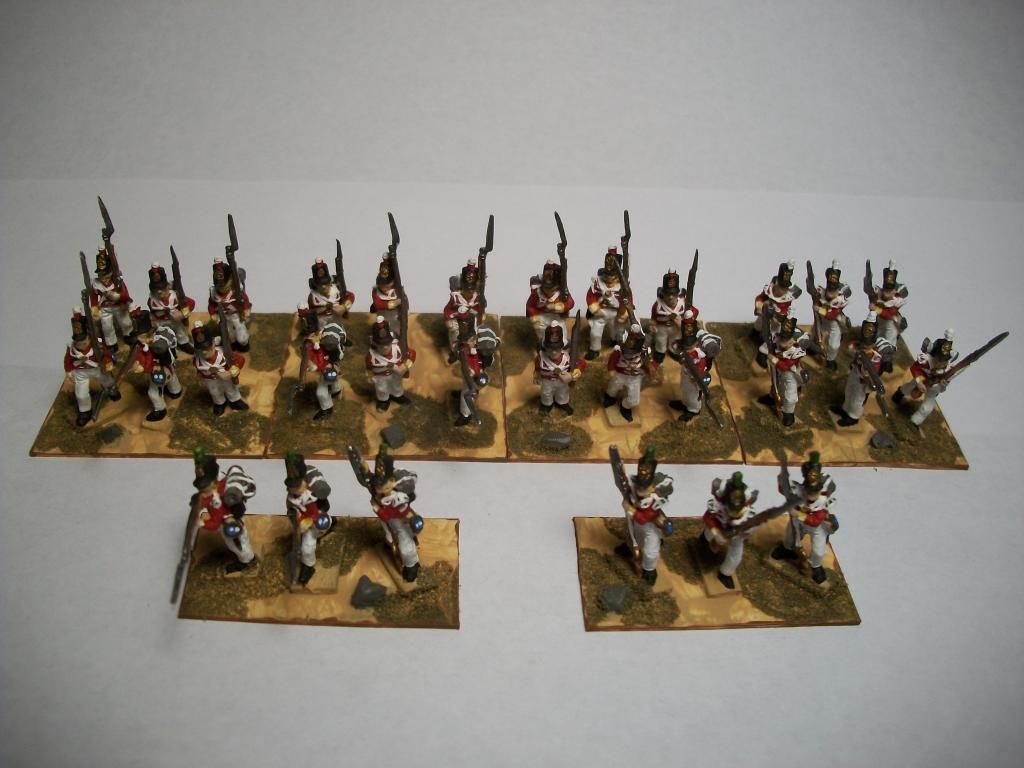
Finally, I completed six Minifigs 15mm British in Belgic shako figures to represent a company of the 5th (Howe's) West India Regiment, which fought at the Battle of New Orleans. The unit was a 'colored' Regiment, consisting mostly of former slaves and freedmen and commanded by white officers. These units performed well and were mostly tollerant of the equatorial diseases which devestated European soldiers serving in the Carribean. This and the other West Indies Regiments had distinctive uniforms, especially after 1812, with Belgic shakos, jackets with rounded lapels of the facing color and piped shoulder straps, and light blue trouser-gaiters.


Purchased Figures

If you keep track of such things, you may have noticed that the "Purchased" columns of the 2015 Totals box have been crreping steadily upwards. Most of these figures were AB orders that I placed in order to flesh out the figures that I already have in order to complete several units, as well as the figures I wanted for a couple of command stands (Wellington and Marshal Ney). I also picked up nine mounted Russian general staff officers off of eBay, as well as another 1/72 Strelets set: French Foot Dragoons and Polish Grenadiers, Set 009. I got these mainly for the foot dragoons, of which I will eventually painted up a full Regiment, probably the 16th Dragoons, though the Poles will be useful for fleshing out the Vistula Legion.

With me leaving for boot camp next week, I doubt I'll get much more painted until well into the summer at the earliest, so I think that this year I'll probably be in the negative numbers for my "totals."

Books

I picked up three books which may or may not be interesting to y'all out there. The first is a new set of rules, the second is a non-fiction book, and the third is a Napoleonic fiction novel.


Recently I recieved in the mail a new set of rules: Field of Glory Napoleonics. I've spent the last couple of weeks looking them over, so I thought that I'd write down some initial impressions. That being said, of course, without playing a game with them it's impossible to get a full picture of the game's nuances. Basically, it's a Corps level game, with emphasis on grand tactical maneuvering. From what I can tell, the rules strive to be very period specific, with a plethora of charts and tables that represent the different troops of the Napoleonic Wars, as well as emphasizing the use of period-appropriate tactics in order to be successful. Since it's a corps level game I won't have enough figures painted to play it any time soon, but it will be nice to have for big battles in the future.


I picked up this non-fiction book on eBay because I was running out of things to read and it was cheap: The Frigates: An Account of the Lighter Warships of the Napoleonic Wars, by James Henderson, CBE. This is a historical monograph chronicling the majority of the frigate actions fought by the Royal Navy, begining in 1793 when Revolutionary France declared war on Great Britian and going through the end of the Napoleonic Wars in 1815. The frigate actions between the Royal Navy and my own United States Navy during the War of 1812 are also discussed. I've only just begun reading it, but it is well written and is very detailed.


Finally, I picked up Sails on the Horizon: A Novel of the Napoleonic Wars by Jay Worrall. This is a fiction book, written in the same spirit as Patrick O'Brien's Jack Aubrey/Stephen Maturin novels and  C.S. Forester's Horatio Hornblower novels. The novel opens in 1797 at the Battle of Cape St. Vincent, and follows the early career of a lieutenant named Charles Edgemont as he is promoted to Commander, finds love, and goes to sea, fighting his own frigate for the first time. I read it in two days; I thought it was well written and quite the page-turner. If you like O'Brien or Forester, check this one out.

Coming soon: Currently I'm working on another command stand, Marshal Ney. When Ney first arrived from AB, he was slightly miscast, missing his right foot. A little bit of green stuff later and no one's the wiser. He and his two companions are primed and I've already started painting them.


Other than that, I don't have much more to say. I'll post Ney when he's done, then we'll see how much time I have left remaining here in Kentucky; I leave for US Navy boot camp a week from today.

Questions, comments and suggestions are always welcomed and appreciated. Thanks for looking!

-Chuck

Wednesday, January 7, 2015

Happy New Year! (Featuring 'The Dandy King')

Happy New Year everyone!

I hope everyone has been having a good start to their 2015s... I know that I have. Things have been pretty productive for me too, at least in the last few days. The 1/88th Regiment of Foot is well underway, as is a stand of the 5th West Indian Regiment. I've purchased some more 1/72 figures, and, lastly, I've finished a command stand: Marechal de France Joachim-Napoleon Murat, Roi de Naples.

(Remember to click on the pictures for bigger versions.)


Here are all of the figures mocked up on their oval base. The figures come from three different sets: Murat is from Strelets #0003, the officer standing with the telescope and the mounted officer are both from Italeri set #6018, and the two horses standing in the back are from Italeri # 6016.
This stand is supposed to represent Murat as he would have been during the Russian Campaign of 1812, though because he fought for many years in the Peninsula I'll probably use this stand for both theaters when I game. Murat was called "The First Horseman of Europe" by his brother-in-law Napoleon Bonaparte, and he was known for being both a flamboyant dresser and a dashing and able cavalry commander. He was the King of Naples from 1808 until his death in 1815. This, combined with his elan, earned him the sobriquet "the Dandy King." A very interesting character, and one of those men that makes the Napoleonic Wars such an interesting period of history to study.

I painted Murat based on a number of different pictures that I found from various sources around the Internet, wearing a green undress coat, low czapka style hat with feathers, white trousers piped red and riding boots. His horse has been saddled with a tiger pelt; I cut this out of a piece of paper and stiffened it in place over the saddle with super glue. I am really pleased with my painting on the tiger pelt; it turned out really good. I couldn't resist giving Murat a tiger pelt once I saw a picture of Murat riding a horse with one.

The two officers Murat is with are from two different hussar regiments. At Borodino Murat had in his cavalry corps the 5th through 9th Hussar Regiments, and here I've depicted officers of the 6th (red and blue) and the 8th (red and green). Their horses are saddled appropriately for their regiments as well.

1/72 Review" Italeri #6001: Scots Greys

Initial Impressions

I picked these up on eBay because they were cheap and I won the auction. I was excited because according to Plastic Soldier Review this set came with 18 figures, which is a full unit of cavalry per box. So before they arrived I had been planning on using them for the 1st and 4th Dragoons, wearing watering caps for the Peninsula. I was a bit peeved when they arrived and one of the boxes was missing a whole sprue.

The two boxes of Scots Greys. One of them was still sealed, while the other was opened. The opened box only contained one of the two sprues in this set.
These guys are in the 1815 uniform of the Scots Greys as they rode at Waterloo, wearing beasrskins with oilskin covers and post-1812 uniforms. To convert them to Peninsular Dragoons in watering caps I'll neet to trim their hats a little, turn the officer's hat into a bicorne with green stuff, and then paint them to look like the older uniforms. The sculpts are very clean, with no flash, and anatomically correct.

Scaleability

These chaps are closer in size to Revel or hat than they are to the honking great Italeri Imperial Staff and Line/Guard artillery. The horses are much smaller and the figures are noticably smaller as well compared to other Italeri mounted figures that I've worked with.

Sprue #3
 Quality

Though they are smaller, these guys are of the same quality that I'm used to with Italeri. There are no prominent mold lines, no flash to speak of, and the scupting is top notch. These guys will be a pleasure to convert and paint.

Sprue #2

Price

Like I said, the only reason I bought these guys in the first place was because they were really cheap. I got 27 horses and riders for $9 and some change, which averages about $0.33 per figure. This is a bit more expensive than I've bought 1/72 figures for in the past, but I was also expecting to get 9 more horses and riders.

Overall I like these guys, and they'll be painted up as one of the Dragoon regiments that served in the Peninsular War, like the 1st or the 4th.

Coming Soon: I've got the 1/88th and a stand of the 5th West Indian Regiments halfway done on the workbench right now, and hopefully I'll be able to finish these guys by the end of the week. Some of you may notice the "2015 Totals" box at the top of the blog tracking my painted vs purchased figures; all of these figures will put me back in the positive again, for the time being anyway. I've also ordered a new rule set to look over; I'll discuss it when it arrives in the mail.

Questions, comments and suggestions are always welcomed and appreciated. Thanks for looking!

-Chuck